
The Crucible in the Dark and the Pioneer Who Entered Our Dust
Scripture Anchor: Hebrews 2:10, 14–18; 5:7–8
I. In the Trenches: The Unfiltered Story
People often ask when the trial started, as if life gives you the courtesy of a clean, peaceful “before” and a tragic “after”.
Mine didn’t.
The furnace of trials did not wait for adulthood, and it didn’t even begin on the night I first realized I was trapped. The fire was lit way before then. Long before I had the cognitive ability to frame a sentence, I inherited an active combat zone rather than a playground.
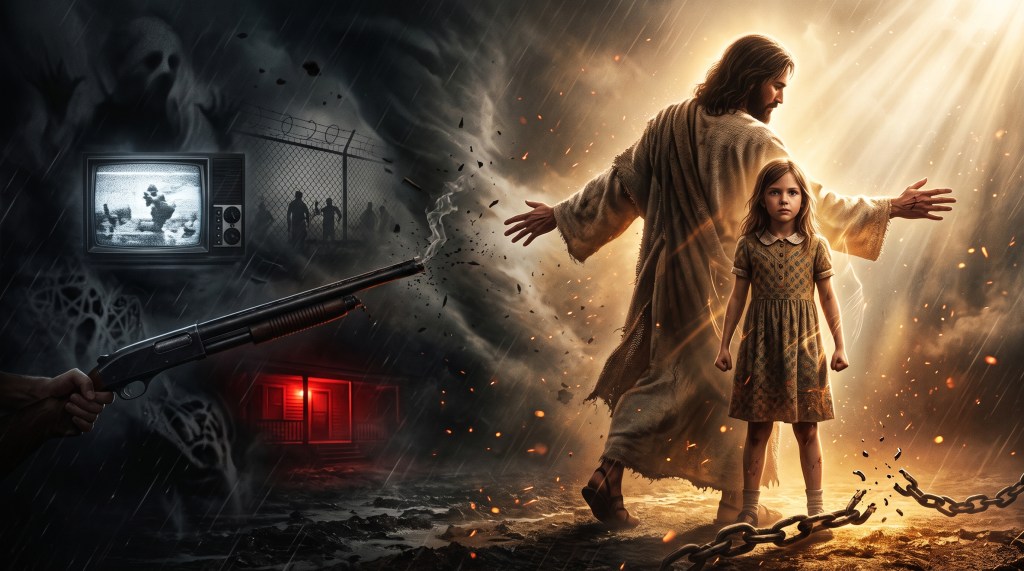
My very first memory on this earth was Hurricane Camille tearing through the outside world, howling against the walls of the house, while the harsh phosphor glow of an old black-and-white television flickered inside. On that small, buzzing screen, the Vietnam War played out in grainy shades of gray: young soldiers wading waist-deep through dark, murky water, their rifles held high over their heads to keep the powder dry, while the tinny little speakers rattled with the crackle and pop of active gunfire.
I don’t remember nursery rhymes. I remember soldiers fighting for their lives in deep water with weapons held above the flood.
That was the primordial wallpaper of my life: wind that could rip a roof off, and men in combat. Looking back, that broadcast was an early dispatch from the reality into which I had been dropped. The ground beneath me was never still.
Soon enough, the violence wasn’t confined to a television screen or a weather report; it moved into my own bones and under our roof.
I grew up with deep, constant pain in my legs. While other children ran down the road and raced their bicycles until the streetlights came on, I couldn’t run or ride bikes like normal kids. My physical body felt like an early cage, locking me out of the effortless freedom that everyone else took for granted. And right outside, the physical landscape reinforced that captivity: I spent those early days living in the literal shadow of a prison fence, watching chain-gang prisoners bent low in the dirt, working the fields under the heat of the sun and the watchful eyes of armed guards.
Inside the house, the psychological torment was relentless. My uncle suffered from paranoid schizophrenia, completely consumed by the delusion that the mafia was hunting our family down to slaughter us in our beds. When you are that small, you cannot separate an adult’s psychosis from reality. If an adult tells you that assassins are casing the windows, your nervous system registers imminent death. Every passing pair of headlights, every floorboard creak, and every footstep outside sounded like an executioner arriving.
Even the places that should have offered sanctuary were stalked by an ominous dread. On my grandmother’s front porch, there was a red light that radiated something heavy, suffocating, and distinctly demonic. It was an oppressive spiritual weight that told a little girl she was surrounded by forces she could neither see nor stop.
Then the physical boundary collapsed entirely: at five years old, the abuse occurred.
A child’s world is delicate, and when you are abused at five, your innocence is stolen before you even know who you are. Because of my painful legs, the isolation, and the chaos around me, I never went to kindergarten. When I finally took my very first step outside into the world to enter the first grade, I walked straight into another trap. My first-grade teacher was not a gentle, nurturing mentor; she was an open, practicing witch. The dark, suffocating spiritual atmosphere I had felt under the red light on that porch was suddenly sitting behind the teacher’s desk at the front of the classroom. When my mother discovered what was happening, she intervened swiftly and pulled me out of that school immediately.
Yet the occult seemed to pursue me even to our doorstep. A fortune teller moved in next door. I was a child who naturally avoided going into other people’s houses—my instincts were already wired to distrust unfamiliar thresholds—but she invited me in. Once I was inside, she grabbed my hand and began reading my palm. The darkness and dread in that room were so violent, and what she spoke was so terrifying, that my body completely broke down. I became violently, physically ill, and my mother had to rush me to the emergency room just to be told it was probably a stomach flu.
The spirit of death wasn’t just lurking in the shadows or whispering through occult neighbor ladies; it walked right into our living room with a loaded weapon.
I was eight years old when the screaming reached a fever pitch. My mom stood holding a shotgun, her finger on the trigger, leveled squarely at my dad. She was about to pull the trigger. She was about to blow him away.
In that split second, I didn’t hide under a bed, and I didn’t run out the front door. With the raw, reckless instinct of a child who had already been initiated into combat, I stepped directly between them.
I stood between the barrel of that shotgun and my dad, planting my feet on the floor and refusing to let her shoot him. She had the gun raised, the hammer back, and the lethal force to kill both of us right there in the kitchen. But I stood my ground, staring down the barrel until the trigger stayed unpulled, and death was forced to back out of the room.
Caged by physical infirmity. Watching prisoners through chain-link wire. Haunted by mafia hitmen and demonic porch lights. Violated at five. An occult authority figure at the chalkboard. Rushed to the hospital after a palm reader seized my hand. And staring down the black barrel of a loaded shotgun to save my dad’s life at the age of eight.
Where was there left to turn?
Night after night, I curled into a ball in the dark and offered up desperate, tear-soaked pleas to an unseen God: Please send someone. Please let someone come and rescue me.
And night after night, the silence of the room was agonizing. Nobody kicked down the front door. No soldier broke through the wall.
When rescue doesn’t arrive in the way a child envisions, an insidious conclusion takes root in the soul: God must be indifferent. He sits in an untouchable, celestial palace far above the clouds, deaf to the cries coming from the floor. Or worse: I am simply too marked down, too defective, and too discarded on the clearance aisle of life for Him to bother stepping into this room.
What I could not possibly understand then was that God was not turning a deaf ear to the little girl in the shadows. He was not an armchair spectator. He was preparing a rescue that would go infinitely deeper than escaping a single room—He was forging an indestructible life.
Before I ever heard God speak on a church nursery carpeted floor decades later, He had already watched an eight-year-old girl stand in the breach between a loaded shotgun and sudden murder. The furnace started early because the assignment was massive. He was drafting a warrior in the fire.
II. The Scalpel: Laying the Text Bare
If human religion had written the script of salvation, God would have solved our dilemma from an ivory tower. He would have issued sterile advice from the clouds, dispatched an immune angel to lecture us about pain, or remained entirely insulated from the blood and muck of earth.
The Epistle to the Hebrews shatters that clinical illusion with one of the most astonishing declarations in the New Testament:
“Since therefore the children share in flesh and blood, he himself likewise partook of the same things, that through death he might destroy the one who has the power of death, that is, the devil, and deliver all those who through fear of death were subject to lifelong slavery. For surely it is not angels that he helps, but he helps the offspring of Abraham.”
— Hebrews 2:14–16 (ESV)
1. The Incarnational Solidarity: Taking Hold of Dust
Notice the precision of the Greek text in verse 14. The author states that humanity shares in “flesh and blood” (haimatos kai sarkos). In response, Jesus did not send an angelic courier. He “likewise partook of the same things” (meteschen tōn autōn).
- He Did Not Assist Angels (v. 16): The verb translated “helps” or “takes hold of” is epilambanetai. It does not mean waving from a safe distance; it means to seize, grasp with the hand, or drag someone out of mortal danger. Jesus bypassed the unfallen, immune angelic orders to grasp bleeding humanity.
- Biological Vulnerability: Jesus put on human flesh. He felt physical limitation, thirst, betrayal, the terror of hostile environments, and human tears. He was hunted as an infant by a murderous king, raised to see and feel the poverty all around him, and bore the brutal impact of violence.
2. Destroying the Lifelong Fear of Death
Verse 15 exposes the exact psychological and spiritual prison that held my early years captive: “and deliver all those who through fear of death were subject to lifelong slavery.”
- The mafia delusions, the demonic porch light, the palm reader’s sickening curse, the practicing witch at the chalkboard, and staring down a loaded twelve-gauge shotgun were all weaponized instruments of the fear of death and destruction.
- Christ took on mortal flesh specifically to katargeō—to render powerless, break the backbone of, and legally disarm—the devil’s authority over that terror.
3. Standing in the Gap: The Archēgos in the Breach
In Hebrews 2:10, Jesus is hailed as our Archēgos—the Pioneer, the Captain, the Champion who steps out in front of His people into the line of fire.
When an eight-year-old child stands between a leveled shotgun and her father, she is acting out the primordial reflex of an intercessor. A mediator does not stand safely behind the walls; a mediator stands directly in the crosshairs. In Hebrews 7:25, we are told that Christ lives forever to make intercession for us. He threw His own body between the wrath of death and our helpless lives, taking the full brunt of the threat upon Himself so that we might live.
III. The Mirror: The Waiting Room vs. The Incarnational Pioneer
When we examine our early furnaces through the mirror of Hebrews, it dismantles the core accusation of trauma.
For decades, I looked back at that dark bedroom, the aching legs, the fortune teller, and that loaded shotgun, and saw only an untethered disaster.
An armchair theologian, sitting in theoretical comfort, cannot understand this. They will offer tidy, superficial slogans: “Everything happens for a reason,” or “Just give it to God and smile.” Those shallow platitudes bounce right off a child who has stood in front of a shotgun barrel.
Hebrews offers something far sturdier than a slogan: it offers a Brother who bled.
Jesus did not abandon me in that house. While I thought I was crying into an empty void, the Pioneer was right there in the dust with me. He was logging every tear (Psalm 56:8), counting every tossing, and anchoring my survival to an indestructible life (Hebrews 7:16).
The early furnace was not the place where my story was discarded; it was the original foundry where the Lord began stripping away the luxury of casual, shallow faith. He conditioned my reflexes in the line of fire so that when He finally spoke across a church nursery carpet decades later, my spirit would recognize the charge: “Warrior.”
IV. The Autopsy: Piercing Questions for “Today”
- The Spirit of Terror (Hebrews 2:15): Look back at your earliest memories of terror, occult exposure, or violence. Where has the enemy tried to use those moments to convince you that death, fear, and trauma have legal ownership over your future?
- Standing in the Line of Fire: Have you ever had to step between someone you loved and total destruction? How does realizing that Jesus threw His own body into the breach on your behalf transform how you view His role as your High Priest?
- The Sympathetic High Priest: When fear tries to seize your hands or make your body sick today, do you run to human fortresses, or do you run boldly to the Pioneer who took on mortal dust and broke the power of the grave (Hebrews 4:15–16)?
A Living Prayer
Lord Jesus,
I bring the little child who cried out in the dark into the light of Your presence. Forgive me for the years I spent believing the lie that You were indifferent, distant, or blind to my tears.
Thank You for not staying in an ivory tower. Thank You for taking on human dust, entering our fragility, and learning obedience through loud cries and real suffering. You saw the storm of Camille; You saw the pain in my limbs; You saw the chain-link fence; You saw the violation of my innocence; You saw the dark words of that fortune teller; and You stood with me when I stepped in front of that shotgun barrel. You did not let death pull the trigger.
Today, I stop looking at my early life as a wasteland of discarded years. I recognize the early furnace as the ground where You preserved my life and began hammering out the steel of a warrior.
I lay down the victim’s rag and pick up the sword of Your Word. Anchor my soul behind the veil and let the scars of my youth become the living authority through which I point others to the seated King. Amen.
To Be Continued …


Leave a Reply