
Part 3
There is a fine line in the Christian life between patient waiting and passive paralysis. We often pray for God to move, yet when circumstances demand courage, we hesitate—wondering if taking an initiative somehow shows a lack of faith.
That is the tension gripping Ruth and Naomi as the harvest draws to a close. For weeks, Ruth has enjoyed daily provision in Boaz’s fields. But barley season doesn’t last forever. Winter is coming, and without a permanent protector and husband, Naomi and Ruth will soon find themselves right back where they started: vulnerable, impoverished widows facing an uncertain future.
Naomi realizes that trusting God does not mean sitting on the sidelines. She devises a bold, culturally specific plan for Ruth to approach Boaz at the threshing floor and formally ask him to fulfill the role of family redeemer.
The Request for Redemption
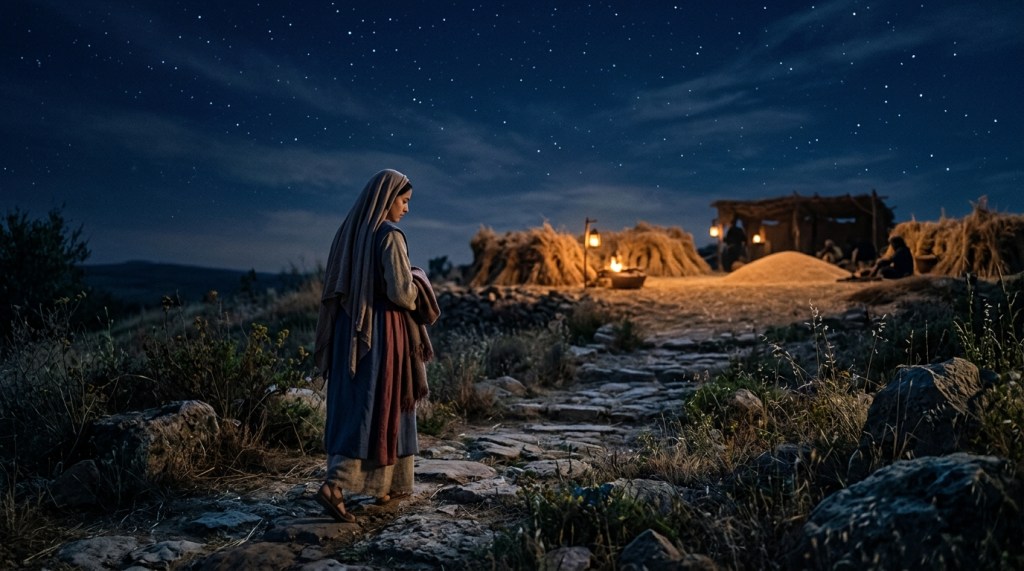
Under the cover of night, after the winnowing celebration has quieted, Ruth approaches where Boaz sleeps by the grain heap:
”He said, ‘Who are you?’ And she answered, ‘I am Ruth, your servant. Spread your wings over your servant, for you are a redeemer.’ And he said, ‘May you be blessed by the Lord, my daughter. You have made this last kindness greater than the first, in that you have not gone after young men, whether poor or rich. And now, my daughter, do not fear. I will do for you all that you ask, for all my fellow townsmen know that you are a worthy woman.’” — Ruth 3:9–11 (ESV)
The Power of the Go’el (Kinsman-Redeemer)
To understand Ruth’s request, we have to look at an ancient institution in Old Testament law: the Go’el (גֹּאֵל), or Kinsman-Redeemer (Leviticus 25:25; Deuteronomy 25:5–10).
In ancient Israel, God designed the Go’el to prevent families from falling into permanent generational poverty. If a man died without heirs or had to sell his family land to survive debt, his nearest kin had a responsibility to:
- Buy back the land: Restore the family inheritance so it stayed within the clan.
- Marry the widow: Provide children who would carry on the deceased husband’s name and inherit the estate.
Fulfilling the role of a Go’el was costly. It required three specific qualifications:
- The right to redeem: You had to be a genuine blood relative.
- The ability to redeem: You had to possess the financial wealth to buy back the property and support the household.
- The willingness to redeem: You had to voluntarily choose to sacrifice your own estate for another’s benefit.
“Spread Your Wings”: Becoming God’s Shelter
When Ruth asks Boaz to “spread your wings over your servant” (ufarasta knfekha), she is using profound imagery.
In chapter 2, Boaz prayed that the Lord would reward Ruth, under whose wings (kanaf) she had come to take refuge. Now, Ruth brings those exact words back to him. She is saying, in effect: Boaz, you prayed that God would shelter me under His wings; now will you be the hands and heart of God by spreading your wing over me in covenant marriage?
Faithful prayer often circles back to demand faithful action. Ruth doesn’t merely hope for an abstract miracle; she invites Boaz to be God’s tangible instrument of redemption.
Integrity at the Threshing Floor
The threshing floor in the ancient world was notorious for moral vulnerability, yet this passage is marked by extraordinary purity and mutual honor.
Notice Boaz’s reaction. He doesn’t take advantage of Ruth’s vulnerability or treat her as an opportunist. He calls her a “worthy woman” (eshet chayil, the same Hebrew phrase used for the Proverbs 31 woman). Furthermore, Boaz refuses to take an illegal shortcut. He honestly informs Ruth that a closer relative has the first right of refusal and promises to resolve the legal matter honorably the very next morning.
True godliness never cuts ethical corners to achieve a good outcome. Boaz and Ruth model that bold faith and unwavering integrity walk hand in hand.
Living It Out This Week
- Distinguish patience from passivity: Recognize when God calls you to stop waiting on the sidelines and take a prayerful, obedient step of courage.
- Maintain uncompromising integrity: Refuse to compromise ethical standards or cut moral corners, trusting that God’s blessings never require ethical shortcuts.
- Rest in your true Redeemer: Remember that Boaz points directly to Jesus Christ, our ultimate Go’el, who possessed the right, the resources, and the willing heart to redeem us from spiritual poverty.
Join the Conversation
- Have you ever caught yourself using “waiting on God” as an excuse for fear or passivity?
- How does Boaz’s refusal to cut ethical corners challenge the way our culture approaches success?
- Where in your life do you need to be reminded that Christ is your willing and capable Redeemer today?
Share your thoughts in the comments below—I’d love to hear your perspective.
A Closing Prayer
Lord, grant us holy boldness to step out when You call us to act, and steadfast integrity to honor You in every detail. Thank You for Jesus, our true Kinsman-Redeemer, who paid the cost to bring us from emptiness into Your covenant family. Amen.
Scripture quotations are taken from the ESV® Bible (The Holy Bible, English Standard Version®), copyright © 2001 by Crossway. Used by permission. All rights reserved.


Leave a Reply