
Part 2
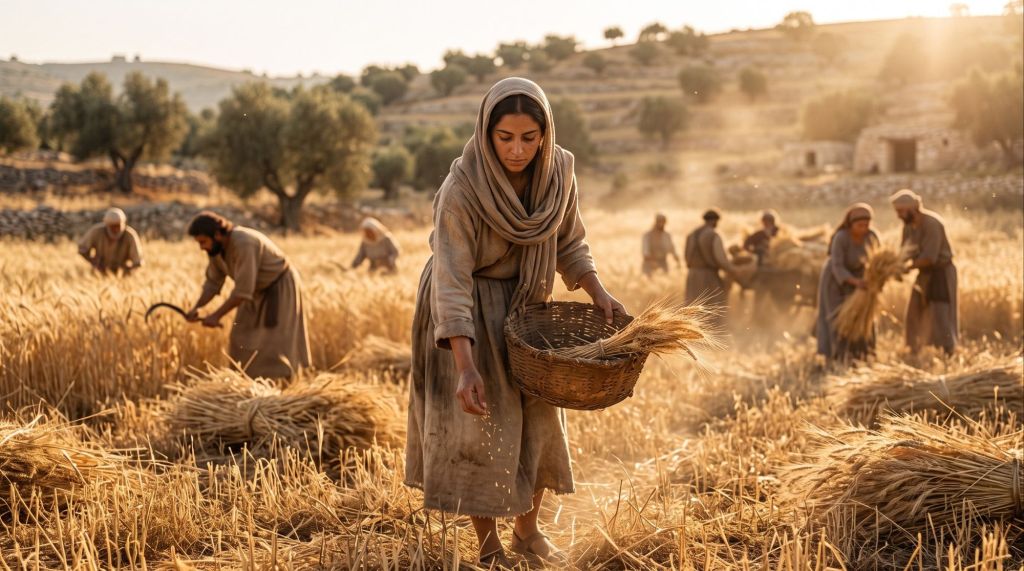
After the gut-wrenching grief of chapter 1, Ruth and Naomi face an immediate, practical crisis: they have to eat.
There are no parted seas, no angelic visitations, and no audible voices from heaven. Survival in Bethlehem simply requires someone to pick up a basket, walk into the dust under the hot sun, and get to work. Ruth steps up to glean behind the harvesters—stooping for hours to gather stray barley stalks left behind. It was humble, exhausting, and often dangerous labor for an unprotected foreign widow.
Yet it is right in the middle of this mundane daily grind that God turns the entire story:
”So she set out and went and gleaned in the field after the reapers, and she happened to come to the part of the field belonging to Boaz, who was of the clan of Elimelech.” — Ruth 2:3 (ESV)
The Divine “Coincidence”
The narrator uses a phrase that in Hebrew literally reads: “her chance chanced upon”, often translated as “she happened to come.”
In ancient biblical storytelling, this is a deliberate literary wink to the reader. What looks like sheer coincidence or random luck on the surface is actually the invisible hand of God orchestrating provision behind the scenes. Ruth didn’t have a divine map or a detailed 5-year plan; she simply took the next faithful, practical step to care for Naomi, and God guided her steps directly into the field of her future redeemer.
Dignity in the Law of Gleaning
Ruth’s labor reflects God’s intentional design for human dignity established in the Old Testament Law (Leviticus 19:9–10; Deuteronomy 24:19).
God commanded landowners never to harvest to the very edges of their fields or collect dropped stalks. This was not a passive handout that fostered dependency or shame. It was an economic safety net that honored the dignity of the poor, the immigrant, and the widow by inviting them to participate in their own provision through honest work.
Boaz: Becoming the Answer to His Own Prayer
When Boaz arrives from Bethlehem, his character immediately transforms Ruth’s reality:
”Then Boaz said to Ruth, ‘Now, listen, my daughter, do not go to glean in another field or leave this one, but keep close to my young women. Let your eyes be on the field that they are reaping, and go after them. Have I not charged the young men not to touch you? And when you are thirsty, go to the vessels and drink what the young men have drawn.’ … The Lord repay you for what you have done, and a full reward be given you by the Lord, the God of Israel, under whose wings you have come to take refuge!’” — Ruth 2:8–9, 12 (ESV)
Notice how Boaz puts covenant kindness (Hesed) into practice:
- He guarantees physical and emotional safety: He sternly warns his workers not to touch or humiliate her.
- He dismantles cultural barriers: He invites a foreign Moabite woman to drink water drawn by his male laborers—an extraordinary act of hospitality in a rigid, caste-conscious culture.
- He goes beyond legal minimums: He instructs his reapers to intentionally pull grain from their bundles and drop extra stalks for her to gather.
Boaz becomes the answer to his own prayer. He asks God to reward Ruth under whose wings she sought refuge, and then immediately uses his wealth, land, and social authority to become the very wings God uses to protect her.
Living It Out This Week
- Trust God in the routine: Recognize that God rarely announces His providence with thunder; He directs your steps quietly through honest daily labor and ordinary decisions.
- Honor the dignity in work: Treat everyday responsibilities as sacred spaces of worship, knowing that faithful effort is never wasted in God’s economy.
- Become someone else’s refuge: Look beyond legal or contractual minimums to extend tangible protection, dignity, and generosity to vulnerable people around you.
Join the Conversation
- Looking back over your life, what seemed like a random coincidence that you now recognize was God’s quiet providence?
- How does Ruth’s quiet persistence in the fields change the way you view your own everyday responsibilities?
- What is one practical way you can move past doing the bare minimum to show generous kindness to someone in your workplace or neighborhood this week?
Share your experience in the comments below—I’d love to hear your thoughts.
A Closing Prayer
Father, thank You that You are actively at work even when You seem silent. Grant us faithfulness to honor You in our daily routines and eyes to recognize Your providence in ordinary moments. Make us people who go beyond the minimum to shelter, uplift, and bless those around us. Amen.
Scripture quotations are taken from the ESV® Bible (The Holy Bible, English Standard Version®), copyright © 2001 by Crossway. Used by permission. All rights reserved.


Leave a Reply