
Part 4
In chapter 1, Naomi walked into Bethlehem weeping, heartbroken, and completely depleted. Her opening declaration defined her season: “I went away full, and the Lord has brought me back empty” (Ruth 1:21).
If the Book of Ruth ended in chapter 1, it would be a tragic tale of survival. But biblical faith operates on a much longer arc. Chapter 4 brings us to the resolution of the entire story—not in a secluded private room, but in the public town square where legal justice, covenant loyalty (Hesed), and divine restoration meet.
The Drama at the City Gate
Boaz wastes no time. Early the next morning, he takes his seat at the city gate (sha’ar), the civic courthouse and commercial center of ancient Bethlehem. He calls together ten elders and intercepts the nearer kinsman:
“Then Boaz said to the elders and all the people, ‘You are witnesses this day that I have bought from the hand of Naomi all that belonged to Elimelech and all that belonged to Chilion and to Mahlon. Also Ruth the Moabite, the widow of Mahlon, I have bought to be my wife, to perpetuate the name of the dead in his inheritance… You are witnesses this day.’” — Ruth 4:9–10 (ESV)
The Tale of Two Relatives
This legal scene contrasts two radically different worldviews:
- The unnamed relative (Peloni Almoni): The author intentionally leaves this man nameless, calling him simply “so-and-so.” When Boaz mentions the land, he eagerly agrees to buy it to expand his real estate portfolio. But the moment Boaz explains that acquiring the land includes marrying Ruth to raise up an heir for the deceased, he backs out, claiming it would “impair his own inheritance.” He chose self-preservation, financial safety, and self-interest. In trying to protect his name and wealth, his name is forgotten by history.
- Boaz: Boaz steps forward with open hands. He pays the full financial redemption price, takes on the responsibility of an impoverished family, and welcomes a foreign Moabite widow as his wife. He risked his estate out of covenant love (Hesed), and God stamped his name into eternity.
To seal the deal, the closer relative pulled off his sandal and handed it to Boaz—the ancient Hebrew legal custom confirming the transfer of redemption rights and property.
Naomi’s Restoration: Meshiv Nefesh
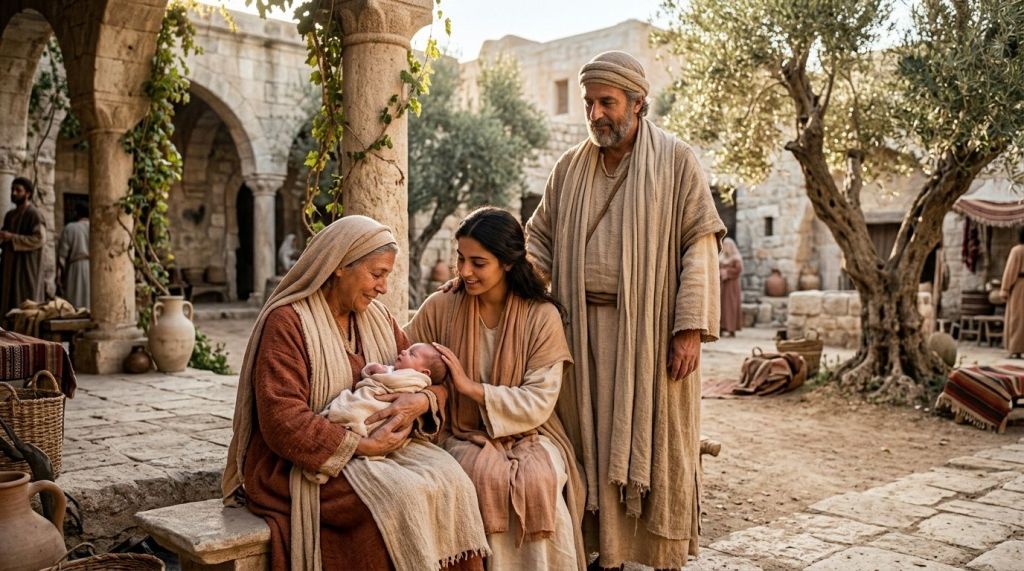
The story reaches its emotional peak not with the wedding, but with Naomi holding a newborn child:
“So Boaz took Ruth, and she became his wife… and she bore a son. Then the women said to Naomi, ‘Blessed be the Lord, who has not left you this day without a redeemer, and may his name be renowned in Israel! He shall be to you a restorer of life and a nourisher of your old age, for your daughter-in-law who loves you, who is more to you than seven sons, has given birth to him.’ Then Naomi took the child and laid him on her lap and became his nurse.” — Ruth 4:13–16 (ESV)
The neighborhood women declare that this child will be a Meshiv Nefesh (מֵשִׁיב נֶפֶשׁ)—literally a “restorer of life,” one who revives a fainting soul and breathes vitality back into a dead situation.
Even more stunning, they tell Naomi that Ruth is “more to you than seven sons.” In the ancient Near East, seven sons represented the absolute pinnacle of earthly security and blessing. For a group of Bethlehemite women to proclaim that a foreign Moabite daughter-in-law exceeded the greatest blessing ancient society could offer shows how completely Ruth’s radical loyalty had won their hearts.
The Generational Horizon
The book does not end with Naomi, Ruth, or Boaz. It closes with a ten-generation family tree:
“Salmon fathered Boaz, Boaz fathered Obed, Obed fathered Jesse, and Jesse fathered David.” — Ruth 4:21–22 (ESV)
Ruth and Naomi never lived to see King David unite Israel. They certainly never lived to see Jesus Christ born in that very same village of Bethlehem centuries later (Matthew 1:5).
Yet God used Ruth’s quiet decision to pick up fallen barley, Boaz’s willingness to pay a financial cost, and Naomi’s persistent survival to weave the lineage of the Savior of the world. What felt like small, fragile acts of daily obedience became eternal links in the history of human redemption.
Living It Out This Week
- Trust God’s long-range redemption: Remember that God works on a generational scale, weaving small daily decisions into eternal purposes you might not immediately see.
- Reject selfish self-preservation: Avoid the mistake of the unnamed relative who guarded his personal wealth at the expense of people, missing out on God’s grander story.
- Anticipate fullness after sorrow: Believe that God never wastes pain, carrying the power to restore joy and purpose to seasons that once felt entirely empty.
Join the Conversation
- How does seeing Naomi hold baby Obed in chapter 4 change your perspective on her grief in chapter 1?
- What makes the unnamed relative’s fear of losing his inheritance a warning for how we make decisions today?
- In what ways does knowing that Ruth’s quiet faithfulness led to Jesus encourage you in your own routine right now?
Thank you for walking through this 4-part journey through the Book of Ruth! Share your reflections in the comments below.
A Closing Prayer
Sovereign God, thank You that You are the ultimate Restorer of our lives. When we feel empty, remind us that You are already orchestrating redemption behind the scenes. Give us generous, unselfish hearts like Boaz, unwavering loyalty like Ruth, and eyes to see Your redemptive hand across generations. We praise You for Jesus, our true and eternal Redeemer. Amen.
Scripture quotations are taken from the ESV® Bible (The Holy Bible, English Standard Version®), copyright © 2001 by Crossway. Used by permission. All rights reserved.


Leave a Reply